TL;DR: In this article, you’ll learn where human guard coverage typically breaks down, what AI video analytics and automation actually do better than people, and how integrating both creates a stronger, more reliable security operation. You’ll see how AI reduces false alarms, improves response times, and gives leadership measurable proof that security is working. The goal is not replacing guards. It is equipping them to perform at a higher level with fewer blind spots.
AI and Automation in Security: Are They Replacing Guard Teams or Fixing the Gaps Humans Can’t Cover?
If you manage a facility, a campus, or multiple locations, you’ve likely asked this question:
Are AI cameras and automation going to replace my guard team?
It is a fair concern. Security budgets are tight. Labor costs are rising. Turnover is real. And your team is already stretched thin.
The truth is simple. AI and automation are not replacing guards. They are fixing the blind spots, fatigue gaps, and response delays that humans alone cannot eliminate.
The strongest security strategies in 2026 are not AI versus people. They are AI plus people.
Where Do Human Guard Teams Struggle Most?
Even the best guard team has limitations. Humans get tired. They get distracted. They cannot watch 100 cameras at once.
Here are the most common gaps we see across manufacturing, healthcare, multi-family, automotive, and education environments:
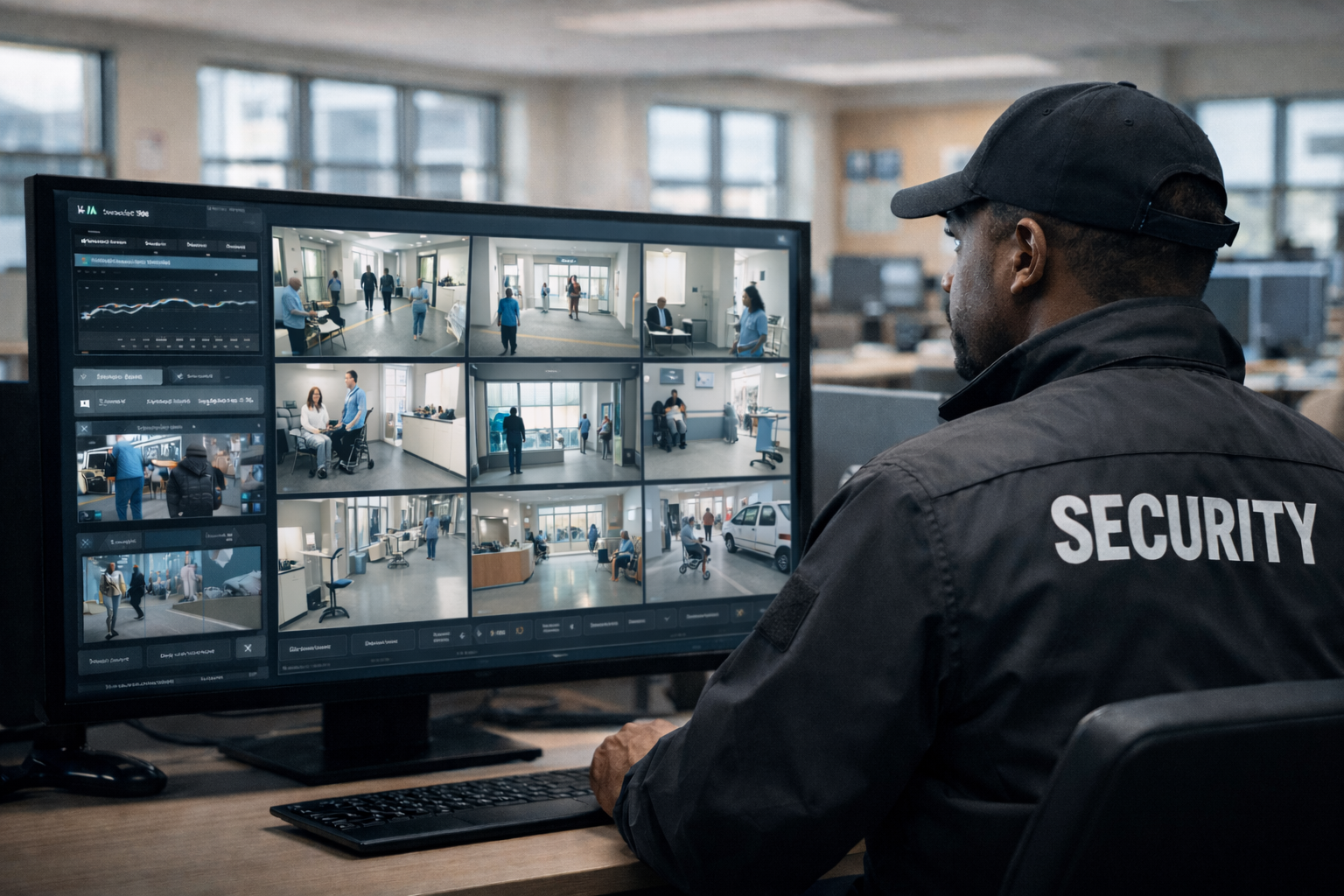
Monitoring multiple camera feeds in real time
Overnight patrol fatigue
Large parking lot or perimeter coverage
Simultaneous incidents across a campus
Delayed response due to lack of verified information
High turnover in contract guard services
A guard can only physically be in one place at one time. A camera system without intelligence can only record what already happened.
This is where AI video analytics changes the equation.
Solutions like Verkada, Avigilon Alta, and Eagle Eye Networks use AI to analyze behavior, not just record video. That means:
Detecting loitering before a break-in occurs
Alerting on unusual after-hours access
Identifying vehicles or people matching descriptions
Flagging weapons or aggressive behavior
Filtering out false alarms caused by weather or animals
Instead of replacing your guard, AI becomes their second set of eyes.
What Does AI Actually Do That Guards Cannot?
AI does not get bored. It does not blink. It does not miss a pattern at 2:37 a.m.
Here is what AI and automation do exceptionally well:
1. Continuous Monitoring
AI video analytics review every frame across every camera simultaneously. No human team can match that scale.
2. Pattern Recognition
AI identifies anomalies. A person entering a restricted area. A vehicle circling repeatedly. A door forced open after hours.
3. Intelligent Alerting
With solutions like SiteWatch Video Monitoring and integrated AI platforms, alerts are verified before dispatch. That reduces false alarms and protects guard resources.
4. Faster Investigations
Natural language search capabilities in platforms like Verkada allow teams to search “red truck between 1–3 p.m.” instead of manually scrubbing footage for hours.
The result is not fewer people. It is smarter use of people.
Manufacturing Facility Reduces Guard Fatigue and False Alarms
A regional manufacturing client relied heavily on overnight guards to monitor perimeter cameras and respond to intrusion alerts. False alarms from wind, wildlife, and lighting shifts were constant. Guards were overwhelmed. Response credibility was slipping.
Hoosier integrated AI analytics with their existing camera infrastructure and layered in monitored response through SiteWatch. The system filtered nuisance alerts and escalated only verified threats.
Within six months:
False dispatches dropped by over 60 percent
Guard overtime costs decreased
Response times improved
Management gained centralized visibility across the site
The guard team did not shrink. Their role evolved. They focused on verified incidents instead of chasing noise.
That is the difference between reactive and proactive security.
How Do You Build an AI + Guard Strategy That Actually Works?
Technology alone does not fix gaps. Integration does.
Here is a simple framework we use with clients:
Identify coverage gaps
Where are incidents missed? Where is fatigue highest? Where is visibility weakest?Layer AI analytics into critical zones
Perimeters, loading docks, parking areas, restricted interior spaces.Integrate with access control and alarms
Platforms like Motorola Solutions ecosystems connect cameras, access events, and alerts into one dashboard.Align guard response protocols
Guards respond to verified, prioritized alerts instead of passive monitoring.Add a service plan
A system only works if it stays online. Programs like Just Fix It ensure uptime and accountability.
When systems talk to each other, your guard team becomes more effective without expanding headcount.
Is This About Cutting Guard Costs?
Not necessarily.
For some organizations, AI reduces reliance on overnight contract patrols. For others, it protects existing guard investment by making it more productive.
The larger goal is reliability.
Your executive team does not want to hear that “someone was watching the screen” when an incident slips through. They want proof that your system actively works to prevent events.
AI gives you measurable data:
Incident trends
Alert response times
False alarm reductions
Coverage analytics
That turns security from a cost center into a performance function.
FAQ
Q: Will AI replace my guard team?
No. AI handles monitoring and pattern detection at scale. Guards handle judgment, physical response, and situational decision-making. The strongest environments combine both.
Q: Is AI video analytics complicated to manage?
Modern platforms like Verkada and Avigilon Alta are designed for operational teams, not engineers. Dashboards are centralized and intuitive. Natural language search reduces training time significantly.
Q: Does AI reduce false alarms?
Yes. AI distinguishes between meaningful motion and environmental noise. That protects guard time and reduces unnecessary dispatches.
Q: Is this only for large enterprises?
No. Mid-sized manufacturers, dealerships, healthcare clinics, and multi-family properties benefit significantly because they often operate with lean teams.
Q: How does this integrate with access control?
Integrated ecosystems connect door events, video clips, and alarms in a single interface. When a door is forced, the associated camera feed and alert appear instantly.
The Bottom Line
AI and automation are not here to eliminate guard teams.
They are here to eliminate blind spots.
When properly integrated, AI strengthens your people, improves response accuracy, reduces fatigue, and gives leadership measurable proof that security works when it matters most.
The organizations seeing the greatest ROI are not replacing humans. They are equipping them.
Strengthen Your Guard Operations without Expanding Headcount
If you are evaluating how to strengthen your guard operations without expanding headcount, schedule a private session at the Hoosier Security Experience Center.
You will see how AI analytics, access control, monitored response, and service accountability integrate into one reliable system.
Or keep relying on manual monitoring and hoping nothing slips through.
The stronger option is measurable protection.
Schedule your visit today.