TL;DR: Security systems are now being evaluated during operational audits because they directly impact compliance, risk management, and business continuity. Auditors are reviewing access control governance, video retention policies, and documented system maintenance. Organizations using integrated, cloud-based platforms with centralized reporting are passing audits more smoothly, while outdated or disconnected systems are creating unnecessary findings and executive risk.
How Security Technology Is Becoming a Core Part of Operational Audits — And How to Make Sure You’re Ready
Five years ago, security systems were often treated as a separate line item. Cameras were for incidents. Access control was for doors. Alarms were for after-hours protection.
Today, operational audits look very different.
Auditors now ask questions like:
Who accessed your server room last month?
Can you prove that terminated employees were removed from the system?
How do you verify compliance across multiple sites?
What controls prevent unauthorized after-hours entry?
Security technology is no longer just about stopping crime. It is now directly tied to compliance, safety, insurance, operational uptime, and executive accountability.
If your systems are outdated, disconnected, or hard to report on, audits become stressful fast.
Why Are Security Systems Now Included in Operational Audits?
Operational audits have expanded beyond financial controls. They now evaluate risk management, physical safeguards, and system reliability.
Industries like healthcare, manufacturing, education, and multi-site retail are seeing this shift most clearly. Regulations and internal governance policies increasingly require proof of:
Controlled access to sensitive areas
Video retention policies
Incident documentation
System uptime and service response times
Vendor accountability
Modern platforms like Brivo, PDK (Prodatakey), and Verkada make this documentation accessible. Cloud dashboards allow administrators to generate access logs, export video clips, and verify user permissions quickly.
Older, on-prem systems often cannot produce clean audit trails. That is where findings happen.
Auditors do not just want assurance. They want documentation.
What Are Auditors Actually Looking For in Security Technology?
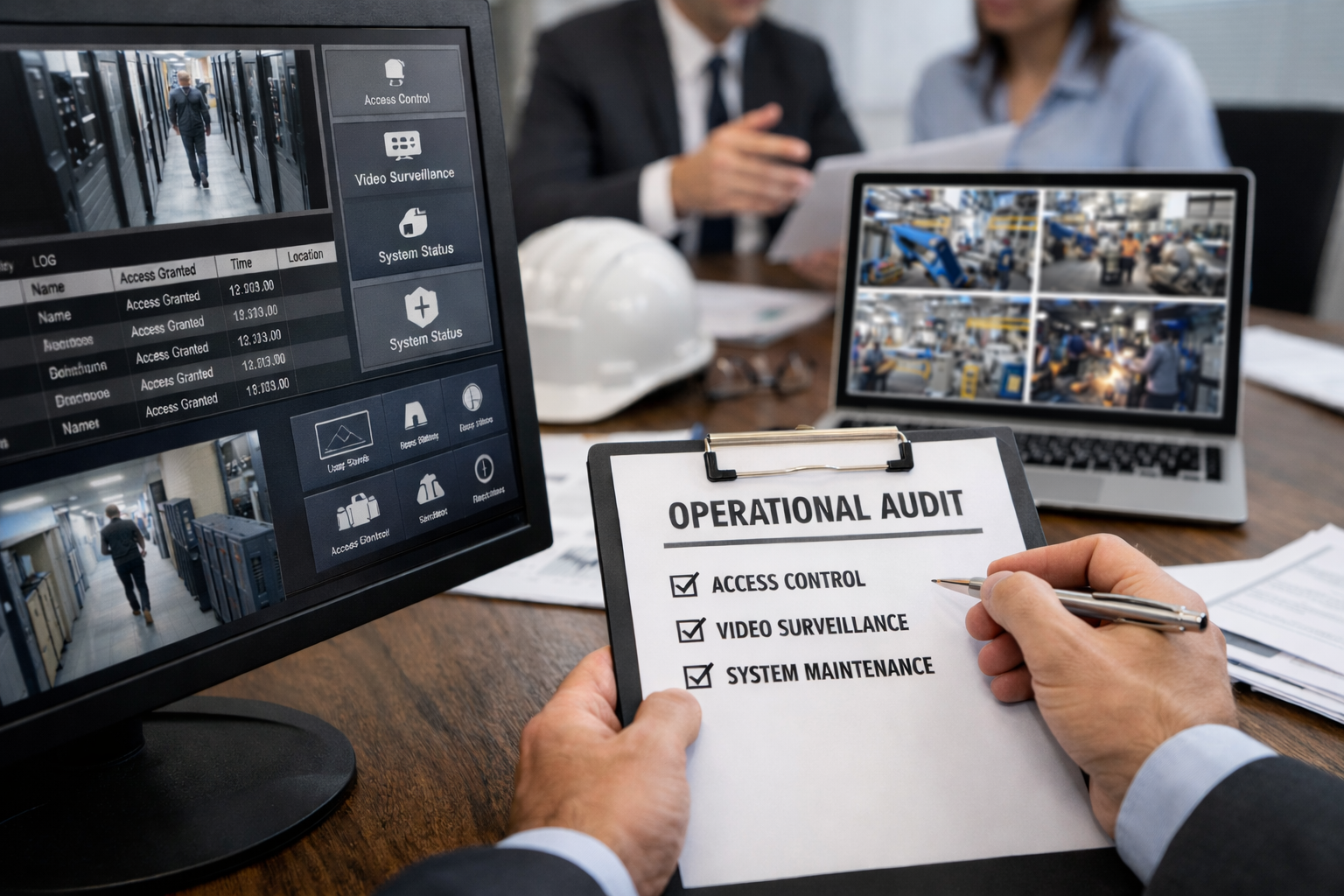
Most operational audits focus on three categories:
1. Access Control Governance
Role-based access permissions
Timely removal of former employees
Restricted access to high-risk areas
Elevator and multi-floor access controls
Cloud-based systems allow IT and HR to coordinate credential management. When an employee is terminated in your HR platform, access can be removed immediately. That level of integration matters during review.
2. Video Retention and Incident Documentation
Auditors want to know:
How long footage is retained
Whether footage can be retrieved quickly
If the system is reliable and recording consistently
AI-enabled video platforms such as those in the Motorola Safety & Security Ecosystem or Verkada provide searchable footage and health monitoring alerts. If a camera goes offline, you are notified. That proactive visibility reduces audit risk.
A camera that was down for weeks without anyone noticing is not just a security issue. It is a compliance issue.
3. System Maintenance and Service Accountability
Audits increasingly review:
Service response time
Warranty coverage
Preventative maintenance plans
Documentation of repairs
This is where a structured service agreement matters. Programs like our Just Fix It Service Level Agreement (JFI) give clients documented response standards and accountability. That paper trail becomes part of your operational proof.
Checklist: Is Your Security System Audit-Ready?
Use this quick internal review:
Can you generate access logs in under five minutes?
Do you have a documented video retention policy?
Are inactive credentials automatically flagged?
Do you receive alerts if devices go offline?
Is your integrator responsive with documented service history?
Can you show proof of regular system health checks?
If you hesitated on more than one of these, your next audit could expose gaps.
Manufacturing Client Reduces Audit Findings
A multi-site manufacturer came to us after an internal audit flagged inconsistent access removal practices and incomplete video documentation.
Their legacy system required manual credential removal. Logs were difficult to export. Cameras at one site had been offline for weeks without notice.
We implemented:
Cloud-based access control with centralized credential management
AI-enabled video monitoring with system health alerts
Standardized retention policies across all locations
A documented service agreement through JFI
Within the next audit cycle, they eliminated prior findings and reduced incident investigation time by over 40 percent. More importantly, leadership gained visibility across every site without losing local control.
Security shifted from being a liability to becoming documented proof of operational discipline.
How Does Integrated Security Improve Audit Outcomes?
Disconnected systems create friction. Integrated systems create clarity.
When access control, video, alarms, and monitoring work together:
Access events can be paired with video evidence instantly
Reports are centralized
Compliance documentation is standardized
Executive teams have dashboard-level oversight
For multi-site organizations, centralized platforms allow headquarters to maintain governance while empowering local managers with day-to-day control.
That balance matters to auditors and executives alike.
FAQ
Q: Are operational audits legally required to review physical security systems?
Not always by law, but increasingly by policy. Many industries incorporate physical safeguards into internal governance, insurance requirements, and compliance frameworks. Even when not mandated, security controls are often reviewed as part of broader risk management.
Q: What is the biggest security-related audit finding?
Improper access control management is one of the most common. Former employees retaining access credentials and lack of documentation around restricted areas frequently trigger findings.
Q: Do cloud-based systems make audits easier?
Yes. Cloud platforms simplify log retrieval, reporting, and centralized oversight. They also provide automatic updates and system health monitoring that reduce blind spots.
Q: How often should security systems be reviewed internally?
At minimum, annually. High-risk industries often conduct quarterly reviews of access permissions and system health to stay ahead of compliance issues.
Q: What happens if we ignore this shift?
Audit findings lead to corrective action plans, executive scrutiny, potential insurance implications, and increased liability exposure. Waiting rarely makes it easier.
Walkthrough Audit-Ready Security in Real Time
Operational audits are not going away. They are becoming more detailed and more integrated with technology.
You have two choices.
Hope your current system holds up under review.
Or make sure it does.
Schedule a private session at the Hoosier Security Experience Center. We will walk you through what audit-ready security looks like in real time and help you identify gaps before someone else does.
Reliable systems. Clear documentation. No surprises.