Most business leaders do not struggle with buying technology. They struggle with trusting it.
You have likely sat through polished demos before. Clean slides. Confident reps. Big promises. Then months later, your system is harder to manage than expected, your team avoids using it, and you are left explaining why the investment did not deliver.
That is exactly why the Hoosier Security Experience Center exists.
TL;DR: The Hoosier Security Experience Center allows decision-makers to test real security platforms before they buy. During a hands-on session, leaders evaluate integration, workflow speed, incident response, and usability across protection, detection, analysis, communication, and response. The result is clearer alignment, fewer implementation surprises, and higher confidence that the system will actually perform under pressure.
Inside the Decision Room: What Clients Learn When They Test Drive Security Technology in the Hoosier Experience Center
When you are responsible for security across manufacturing floors, healthcare facilities, multi-family properties, dealerships, or schools, the stakes are high.
You are not just choosing cameras or access control readers. You are choosing:
Operational visibility
Risk reduction
Accountability
Long-term scalability
A partner you will depend on for years
The wrong choice costs more than money. It costs time, credibility, and operational control.
The Experience Center was built to eliminate guesswork before a system is ever installed.
What Happens When You Test Drive Security Technology Instead of Just Watching a Demo?
In the Hoosier Experience Center, clients do not sit and watch slides. They step into what we call the Decision Room.
They interact with live systems. They see real integrations. They test workflows as if the system were already in their building.
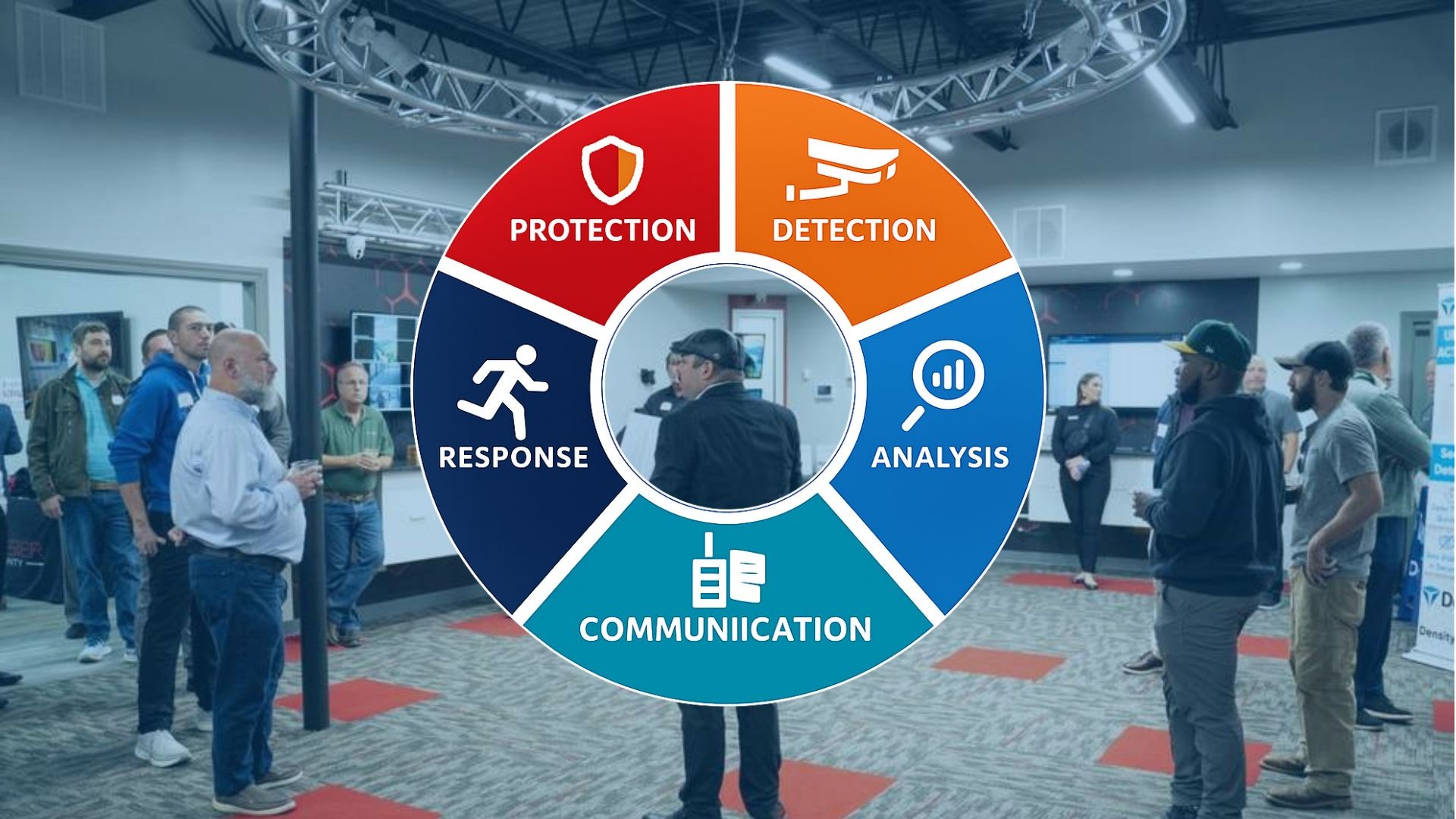
During the tour, clients walk through layered security pillars that include:
Protection
Detection
Analysis
Communication
Response
This structure keeps the focus on outcomes, not features.
Instead of asking, “How many megapixels is the camera?” decision-makers start asking better questions:
How quickly can my team pull footage during an incident?
What does an after-hours alert actually look like?
How do I manage access across multiple sites from one dashboard?
What happens if a sensor detects vape or air quality issues in a restroom?
How does law enforcement receive footage if needed?
That shift changes everything.
What Do Clients Realize About Integration Once They See It Live?
On paper, every platform claims to integrate.
In the Experience Center, clients see real ecosystems working together, including solutions from partners like Motorola Solutions, Verkada, Brivo, and ZeroEyes.
They see how:
AI video analytics flag unusual behavior
Access control ties into video for instant verification
Environmental sensors detect threats beyond visible incidents
Real-time alerts flow to the right people
Video can be shared securely with law enforcement when needed
More importantly, they see how integration reduces friction.
One login.
One dashboard.
One system of record.
For multi-site organizations, this is often the moment they recognize how much time they are currently losing to fragmented platforms.
How Does the Experience Center Reduce Risk Before You Buy?
Most integrators show you a catalog.
We show you consequences.
Clients simulate real-world scenarios:
A forced door after hours
A weapon detection alert
A suspicious vehicle in a lot
A compliance audit requiring access logs
An environmental sensor triggering a health or safety alert
Instead of imagining how their team might respond, they practice it.
They test how quickly they can:
Pull footage
Verify access events
Trigger communication
Escalate to response
This exposes blind spots early.
Sometimes clients realize their internal processes need refining. Sometimes they see that a simpler configuration will work better than an overly complex design. Sometimes they confirm that the platform they thought they wanted is not actually the right fit.
That clarity prevents expensive course corrections later.
What Are the 5 Most Common Insights Clients Walk Away With?
After hundreds of tours, patterns emerge. Decision-makers consistently learn:
Simplicity wins. The system their team will actually use is better than the one with the longest feature list.
Integration matters more than brand names. A unified ecosystem outperforms disconnected best-of-breed tools.
Response speed drives ROI. Faster verification reduces loss, downtime, and liability.
Proactive alerts change the security conversation from reactive to predictive.
Service and accountability are just as critical as hardware.
This is where our Just Fix It service model becomes part of the conversation. A strong system without ongoing support still fails.
Technology must be reliable. But it must also be backed by a partner who answers the phone.
From Uncertainty to Clear Direction
A regional manufacturing client managing multiple facilities visited the Experience Center unsure whether to stay on an aging on-premise video system or migrate to a cloud-based platform.
On paper, both options looked viable.
During the live demo, their IT director tested remote access from a mobile device. Their operations manager simulated pulling footage tied to an access control event. Their executive team saw how centralized dashboards provided multi-site visibility in seconds.
They realized two things:
Their current system required too many manual steps during incidents.
Their team needed centralized oversight without sacrificing local control.
They moved forward with a unified platform strategy. Within months, incident review time dropped significantly, and executive reporting became automated instead of manual.
The investment decision was not based on a sales pitch. It was based on proof.
FAQ
Q: Is the Experience Center just for large enterprises?
A: No. While mid-to-large organizations often benefit most from layered integration, smaller organizations gain clarity just as quickly. The goal is right-sized design, not overselling.
Q: Can we bring multiple stakeholders to a tour?
A: Yes. In fact, we encourage it. IT, facilities, security, and executive leaders often see different priorities. Testing the system together accelerates alignment.
Q: Will we see the exact system we would install?
A: You will see real, live platforms and integrations. Final configurations are tailored to your facility, but the workflows and user experience are authentic.
Q: How long does a tour take?
A: Most sessions run 60 to 90 minutes. It is structured, practical, and focused on your operational goals.
Q: What makes this different from a manufacturer demo?
A: Manufacturer demos focus on their product. The Experience Center focuses on your layered strategy across protection, detection, analysis, communication, and response.
The Bottom Line
You should not have to gamble on security technology.
The Experience Center exists so you can test drive your future system before committing capital. You see how it works. You test how your team responds. You uncover gaps. You make decisions with confidence.
That is how security should be purchased.
Visit the Experience Center
Schedule a private session in the Hoosier Security Experience Center.
Bring your IT lead. Bring your facilities manager. Bring your executive sponsor.
Test your workflows. Challenge the system. Ask hard questions.
Then move forward with clarity.
Explore related insights:
From Surveillance to Intelligence: How AI Video Analytics is Changing the Game
Managing Multiple Facilities with One Security Dashboard: What to Look for in a Platform
Or visit our Experience Center page to book your session.
Security should not be a leap of faith. It should be a decision backed by proof.