Managing security without servers sounds simple until you try to track who is in your building, where they went, and what actually happened.
Most visitor management systems were designed as lobby tools. They check people in, print a badge, and stop there.
But for facilities, operations, and security leaders, that is not enough. You need to know:
- Did that visitor access restricted areas?
- Did they stay where they were supposed to?
- Can you verify activity without digging through hours of footage?
That is where serverless visitor management changes the conversation.
TL;DR: Serverless visitor management systems eliminate on-site infrastructure and connect visitor check-ins directly to access control and video. With platforms like Verkada Guest, you can assign temporary access, track where visitors go, and instantly verify activity through linked footage. The result is full visibility across your facility, faster investigations, and a system your team can actually use instead of manage.What Is Serverless Visitor Management and Why Does It Matter?
Serverless visitor management means your system does not rely on on-site servers to operate. Everything is managed in the cloud.
That shift changes more than IT responsibility. It changes how usable your system actually is.
Instead of:
- Maintaining local servers
- Managing updates manually
- Dealing with downtime across locations
You get:
- Centralized management from one dashboard
- Automatic updates
- Real-time visibility across every site
For multi-site organizations or facilities with limited IT resources, this removes friction immediately.
But the real value is not just removing servers. It is what becomes possible once your systems are connected.
Why Is Visitor Management No Longer Just a Lobby Tool?
Traditional visitor management stops at check-in.
Modern systems extend that data across your entire security ecosystem.
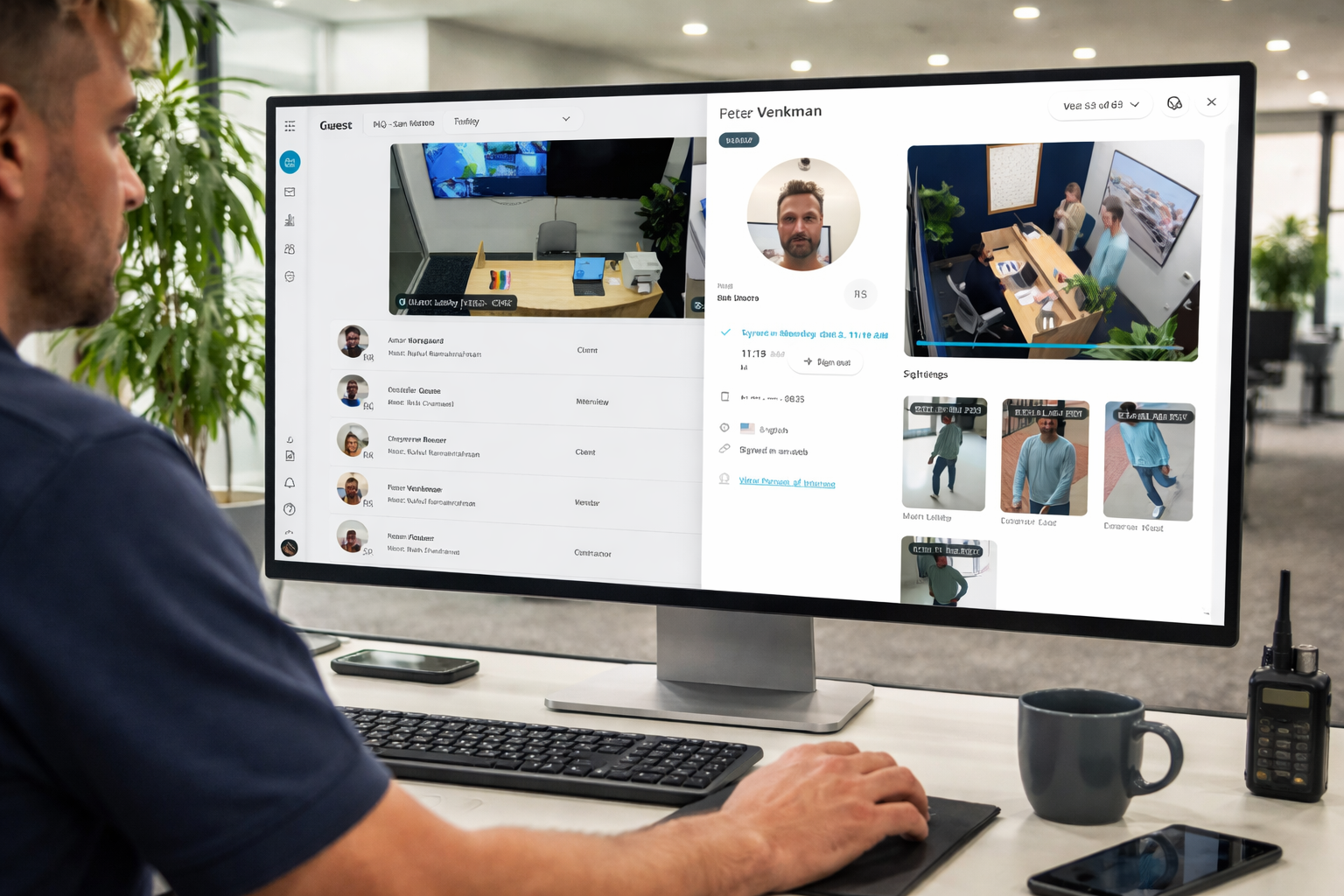
With Verkada Guest, visitor activity becomes part of a larger, connected system:
- Visitor logs connect to access control permissions
- Entry events tie directly to video footage
- Movement can be verified without manual searching
This means your team is no longer guessing what happened after someone signs in.
You can actually see it.
How Does Verkada Guest Connect to Access Control and Video?
This is where the system becomes operational instead of administrative.
Verkada Guest integrates directly with access control and video systems to create a unified view of activity.
Here is what that looks like in practice:
1. Visitor Check-In Becomes an Access Event
When a visitor checks in:
- They can be assigned temporary access credentials
- Access is limited to approved doors and timeframes
- Permissions are automatically revoked when the visit ends
No manual intervention required.
2. Every Entry Is Linked to Video
When a visitor uses a door:
- The system logs the event
- The associated video is instantly accessible
- No need to scrub through hours of footage
Your team can go from question to answer in seconds.
3. Activity Is Searchable Across the System
Instead of pulling logs from multiple systems:
- Visitor name
- Time of entry
- Door used
All become searchable data points tied to video and access history.
This is where visibility becomes actionable.
What Does “Full Visibility” Actually Mean for Your Team?
Full visibility is not more cameras.
It is clarity.
A connected system gives your team the ability to:
- Verify who was on-site at any time
- Confirm whether visitors stayed in approved areas
- Investigate incidents without delays
- Reduce reliance on manual processes
- Improve compliance documentation
This is especially critical in environments like:
- Manufacturing facilities
- Healthcare buildings
- Multi-tenant properties
- Corporate offices with sensitive areas
When systems are disconnected, your team spends time chasing answers.
When systems are integrated, answers are immediate.
From Sign-In Logs to Full Visibility: How One Team Fixed Visitor Accountability
A multi-site corporate office group came to Hoosier after repeated issues with visitor accountability.
Their challenges were clear:
- Visitors were signing in, but movement was not tracked
- Access credentials were not consistently revoked
- Investigations required pulling data from multiple systems
The system was redesigned using a serverless, integrated approach:
- Verkada Guest for visitor management
- Cloud-based access control with temporary credentials
- Video tied directly to entry events
The result:
- Visitor access was automatically controlled and time-bound
- Investigations dropped from hours to minutes
- Security and operations teams had one system instead of three
Their team stopped managing tools and started using them.
What Should You Look for in a Serverless Visitor Management System?
Not all systems deliver this level of integration.
Use this checklist when evaluating your current setup:
- Is visitor data connected to access control?
- Can you instantly pull video tied to a specific entry event?
- Are permissions automated or manually managed?
- Can you manage all locations from one platform?
- Does the system eliminate the need for on-site servers?
If the answer to most of these is no, your system is creating more work than it should.
FAQ
Q: Do I still need servers for visitor management?
A: No. Modern systems operate entirely in the cloud. This removes maintenance, reduces downtime, and allows centralized control across all locations.
Q: How does this improve security compared to a basic sign-in system?
A: A basic system records who entered. An integrated system shows where they went, what doors they accessed, and provides video verification of their activity.
Q: What happens if a visitor overstays or accesses the wrong area?
A: Access can be restricted by time and location. If something goes wrong, you can immediately verify activity through access logs and video tied to that event.
Q: Is this difficult for teams to manage?
A: No. In most cases, it simplifies operations. Everything is managed from one dashboard, reducing the need for multiple systems or manual processes.
Q: Does this work for multi-site organizations?
A: Yes. That is where it delivers the most value. You can manage visitor activity, access, and video across all locations in one place.
Your Visitor Management System Should Do More Than Check People In
Managing security without servers is not just about simplifying infrastructure. It is about creating a system your team can actually use.
If your visitor management system stops at the front desk, you are missing critical visibility across your facility.
The best way to understand how serverless, integrated security works is to see it in action.
Schedule a visit to the Hoosier Security Experience Center and walk through real-world scenarios. Or connect with a Hoosier advisor to evaluate how your current system performs today.
Your system should not just track visitors.
It should help you understand and control what happens after they walk in the door.