Industrial property managers are often the first call when something goes wrong.
A tenant reports vandalism. A contractor claims damage occurred during after-hours work. A visitor slips in a common area. Ownership wants answers. Insurance requests documentation.
And suddenly, your name is part of the conversation.
In some cases, your company may even be named in a lawsuit.
The reality is that liability doesn’t disappear because a property manager wasn’t physically present when an incident occurred. What matters is whether you can quickly determine what happened and provide evidence that supports the facts.
Unfortunately, many industrial portfolios still rely on disconnected camera systems, outdated recorders, or individual building solutions that make footage difficult to access when it’s needed most.
That’s where portfolio video surveillance changes the equation.
TL;DR: Industrial property managers are often held accountable when incidents occur, even if they weren't onsite when it happened. A centralized portfolio video surveillance system helps reduce liability by providing fast access to reliable evidence, visibility across multiple buildings, and documentation that can support tenant disputes, insurance claims, and legal investigations. The goal is simple: one system across your entire portfolio, not one per building.Why Does Liability Increase When You Manage Multiple Properties?
Managing one industrial building is challenging enough.
Managing multiple properties introduces an entirely different level of complexity.
Each site may have different tenants, vendors, access schedules, delivery operations, and maintenance teams. When something happens, gathering information often becomes a manual process involving phone calls, emails, and requests for footage from multiple sources.
The Industrial Property Portfolio Risk Scorecard asks several critical questions:
- Can you see what’s happening across all properties in one place?
- Can you quickly pull footage when someone asks for it?
- Can you easily provide proof to tenants, owners, or insurance providers?
If the answer to those questions is no, your portfolio may have more exposure than you realize.
Because when an incident occurs, the discussion quickly shifts from what happened to what you can prove.
Why Aren’t Cameras Alone Enough to Protect Against Liability?
Many properties already have cameras.
That does not automatically mean they’re helping reduce risk.
A camera system only provides value if:
- The cameras were working when the incident occurred
- The footage was retained
- The video can be located quickly
- The footage clearly documents the event
- The evidence can be shared when needed
We’ve seen situations where footage existed somewhere in the system, but finding it took hours.
We’ve also seen situations where cameras had failed weeks earlier and nobody knew until an incident happened.
At that point, the camera system becomes a missed opportunity rather than a liability defense.
The strongest landlord premises liability video evidence comes from systems that are operational, monitored, and easy to access when questions arise.
What Does Portfolio Video Surveillance Look Like Today?
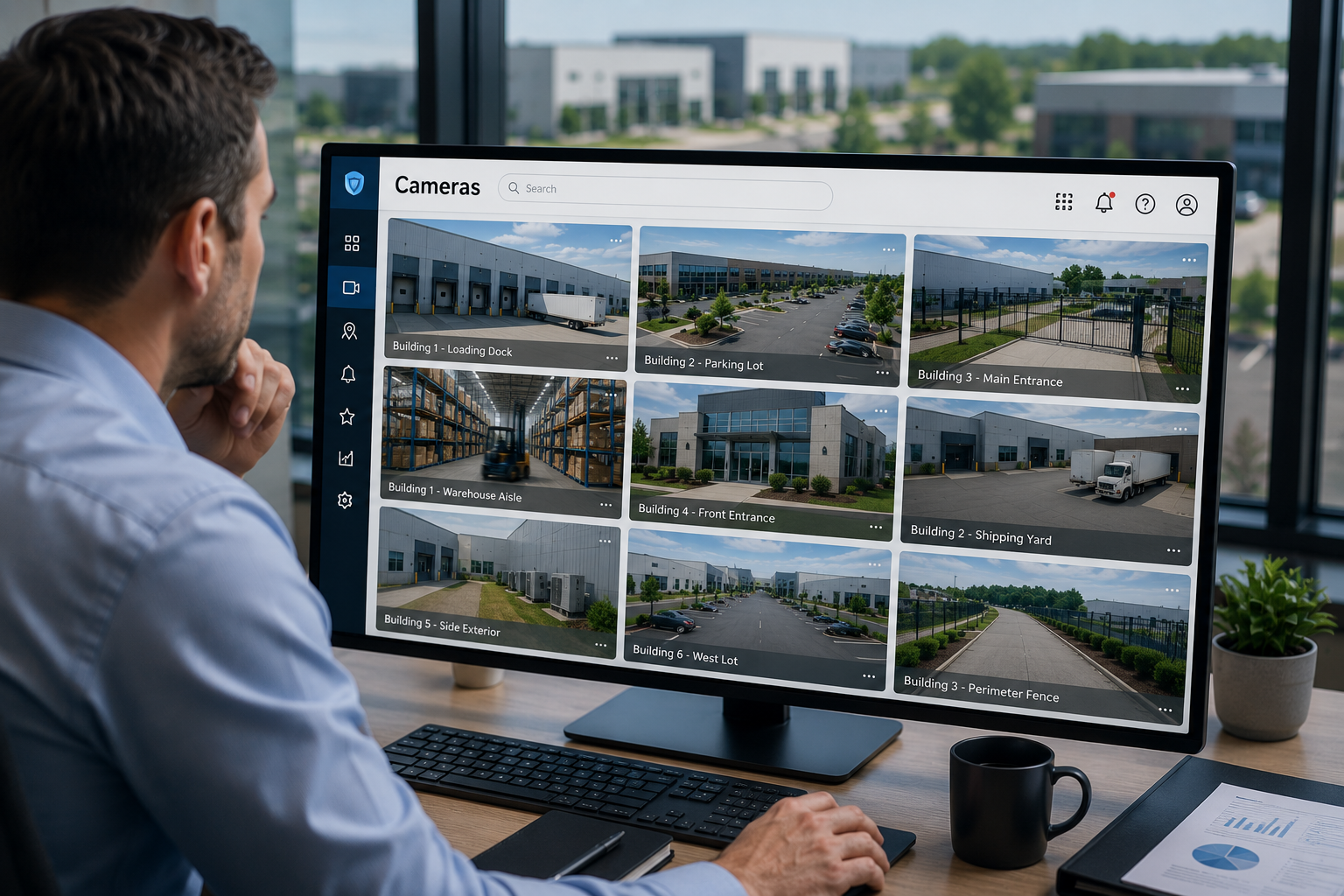
Modern cloud-based platforms allow industrial property managers to manage multiple facilities through a single interface.
Instead of maintaining one system per building, managers can oversee an entire portfolio from one dashboard.
Platforms such as Verkada Command, Avigilon Alta, and Eagle Eye Cloud VMS allow users to:
- View cameras across multiple locations
- Search incidents from a centralized platform
- Access footage remotely
- Manage permissions across properties
- Investigate events without visiting the site
- Share evidence with tenants, owners, law enforcement, or insurance providers
The result is a true multi-site security system that gives managers visibility across their portfolio rather than forcing them to work building by building.
As we often tell industrial property managers:
You need one system across your entire portfolio, not one per building.
How Does Better Visibility Reduce Risk?
Most liability issues become expensive because answers take too long to find.
When ownership, tenants, or insurance carriers ask what happened, delays create uncertainty.
With portfolio video surveillance, property managers can often answer questions within minutes instead of days.
That visibility helps organizations:
Resolve Tenant Disputes Faster
Video evidence removes assumptions and provides objective documentation.
Verify Vendor Activity
Managers can confirm who entered a property, when they arrived, and what occurred while they were onsite.
Support Insurance Claims
Accurate footage helps validate claims and establish timelines.
Investigate Property Damage
Instead of relying on conflicting accounts, managers can review actual events.
Demonstrate Due Diligence
Maintaining documented security records helps demonstrate reasonable efforts to protect the property.
When incidents occur, facts matter.
Video provides facts.
Why Does System Reliability Matter More Than Features?
The most advanced system in the world is worthless if it isn’t working when an incident occurs.
That’s why reliability is often the most overlooked component of commercial property manager security in Indianapolis and throughout the Midwest.
The Industrial Property Portfolio Risk Scorecard specifically asks:
- Can you trust your system to perform when something happens?
- Do your systems work without constant oversight or troubleshooting?
Those questions matter because liability events are unpredictable.
You don’t get advance notice before a vehicle collision, vandalism event, theft, or injury claim.
At Hoosier Security, every qualifying system installation includes a three-year parts and labor warranty because we believe systems should work when they’re needed most.
The footage that protects you in a dispute is the footage that actually exists.
And footage only exists when systems are properly maintained and operational.
Management Team Gains Visibility Across All Locations
An industrial property management group overseeing multiple facilities struggled with incident investigations.
Each building had its own camera system. Access methods varied. Retrieving footage often required contacting different vendors or onsite personnel.
When a dispute arose involving damage to shared property, gathering evidence became a multi-day process.
After migrating to a centralized portfolio video surveillance platform, the management team gained visibility across all locations through a single dashboard. Video retrieval became significantly faster, documentation improved, and ownership gained greater confidence in the property’s ability to investigate incidents and support claims.
The biggest improvement wasn’t the cameras themselves.
It was having one system across the entire portfolio instead of managing separate systems at every property.
Checklist: Signs Your Portfolio May Have Liability Gaps
You may need a better multi-site security system if:
- You manage different camera systems at different properties
- Pulling footage takes longer than a few minutes
- You rely on tenants to report incidents
- Camera health is not actively monitored
- Vendors require separate access methods at different locations
- Ownership frequently asks for information you cannot quickly provide
- Incident investigations require onsite visits
- You’re not confident cameras are recording properly
Even one of these issues can create challenges during a dispute.
FAQ
What is portfolio video surveillance?
Portfolio video surveillance is a centralized approach to managing cameras across multiple properties through a single platform. It allows property managers to monitor, investigate, and manage incidents without switching between separate systems.
How does a multi-site security system reduce liability?
A multi-site security system creates faster access to evidence, improves documentation, and helps verify events. This reduces uncertainty during disputes, insurance claims, and investigations.
What is landlord premises liability video?
Landlord premises liability video refers to recorded footage that documents incidents occurring on a property. It can help establish timelines, verify claims, and provide evidence when disputes arise.
What platforms work best for industrial property portfolios?
Popular cloud-based options include Verkada Command, Avigilon Alta, and Eagle Eye Cloud VMS. These platforms are designed to provide centralized visibility across multiple locations.
Why is cloud-based video management important for property managers?
Cloud-based systems allow managers to access footage remotely, investigate incidents faster, and maintain visibility across their portfolio without traveling to individual properties.
Protecting Your Portfolio Starts Here
When something happens at one of your properties, you shouldn’t have to wonder whether the cameras were working or where the footage is stored.
You should be able to open a dashboard, find the event, and get answers.
That’s the difference between having cameras and having a portfolio video surveillance strategy.
If you’re evaluating commercial property manager security in Indiana, Michigan, or looking for a better way to manage security across multiple industrial facilities, schedule a visit to the Hoosier Security Experience Center.
We’ll show you how Verkada Command, Avigilon Alta, and Eagle Eye Cloud VMS help industrial property managers gain visibility, reduce liability, and manage their entire portfolio from one place.
Because protecting your portfolio starts with knowing exactly what happened.