When a camera goes down, a card reader stops working, or an intrusion panel starts throwing trouble signals, the repair bill is rarely the real problem.
The visible cost might look like a $500 repair. The hidden cost is the service call, after-hours premium, truck roll, parts at retail, return visit, downtime, tenant frustration, and vendor coordination that follows. For property managers and facility teams, one small repair can quickly become a $1,500 to $3,000 incident per property.
TL;DR: Unplanned security repairs cost more than the invoice. Between emergency service, downtime, tenant complaints, return visits, and vendor management, one issue can create thousands of dollars in avoidable expense across a portfolio. A commercial security service agreement like Hoosier Security’s Just Fix It program helps make repairs predictable with one monthly fee, a 1-business-day fix guarantee, free loaners and batteries, and no exclusions.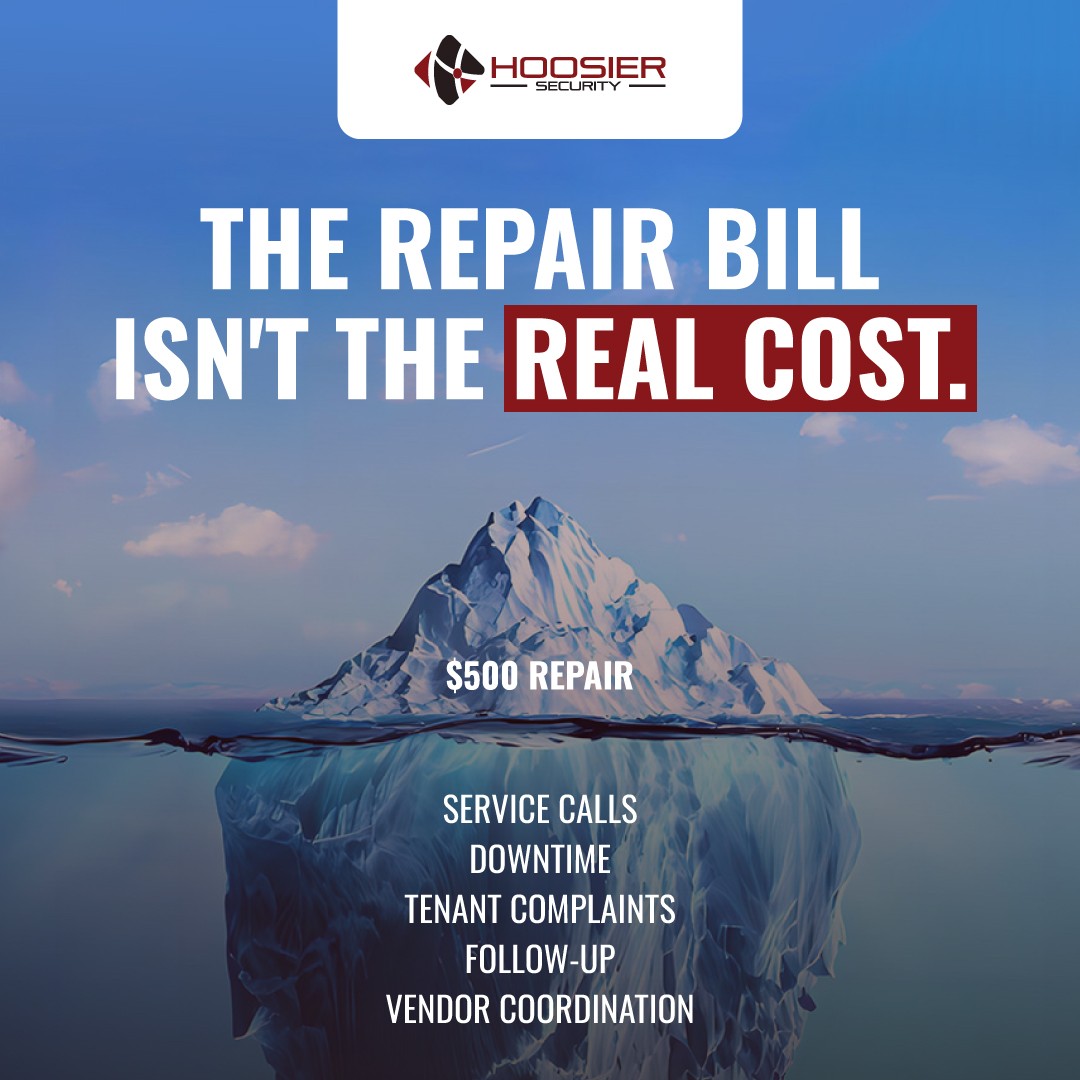
Why Are Unplanned Security Repairs So Expensive?
Unplanned security repairs are expensive because the invoice only shows part of the cost. A broken camera, failed access control reader, weak battery, or offline recorder usually creates a chain reaction.
A typical incident can include:
- Service call fee
- After-hours or emergency response premium
- Truck roll charge
- Diagnostic labor
- Replacement parts at retail
- Return visit if parts are not available
- Time spent coordinating vendors
- Internal time spent updating tenants, managers, or leadership
- Risk exposure while the system is down
That is how a repair that looks like a few hundred dollars can turn into a $1,500 to $3,000 problem per incident, per property.
Across one building, that hurts. Across a multi-site portfolio, it compounds fast.
What Is the Hidden Cost Property Managers Usually Miss?
The hidden cost is not just the money paid to fix the device. It is the operational drag created when the system fails.
For industrial property managers, commercial facilities, and multi-site organizations, one repair can create problems that show up in several places at once. A tenant complains that a gate camera is down. A facilities manager has to track the issue. Someone has to approve the quote. Someone else has to coordinate access for the technician. Then the part is unavailable, so another visit gets scheduled.
While all of that is happening, the property is still exposed.
This is where security system maintenance becomes less about equipment and more about business continuity. Cameras, access control, alarms, and monitoring tools are only valuable when they work at the moment you need them.
How Do Security Repairs Compound Across a Portfolio?
One unplanned repair is annoying. Five unplanned repairs across different properties becomes a management problem.
Portfolio managers deal with repairs differently than single-site operators. They are not only asking, “What broke?” They are asking:
- Which property is affected?
- Is the issue creating tenant risk?
- Is the system still recording?
- Is access control still functioning?
- Are alarms still communicating?
- Who needs to approve the repair?
- Which vendor is responsible?
- How quickly can this be fixed?
This ties directly to the larger issue of vendor management. When every repair requires a quote, approval, service ticket, return visit, and invoice review, the property manager becomes the project manager for problems they should not have to chase.
A strong security system maintenance contract should reduce that burden, not add to it.
What Security System Issues Usually Create Emergency Repair Costs?
Most emergency repair costs come from common failures that are easy to ignore until they affect operations.
Examples include:
- Cameras that stop recording or go offline
- Access control doors that fail to lock or unlock properly
- Badge readers that stop communicating
- Intrusion alarm batteries that fail
- Panels sending repeated trouble signals
- Network or power issues affecting security devices
- Damaged exterior cameras after weather, vandalism, or impact
- Video systems that cannot retrieve footage after an incident
This can happen on systems from Avigilon, Verkada, Hanwha, and other commercial security platforms. The platform matters, but the service model matters just as much.
A good system still needs a good support plan behind it.
Why Does “Wait Until It Breaks” Cost More?
Waiting until something breaks gives the problem control over the timeline.
That usually means your team is reacting under pressure. A tenant is already frustrated. An incident may have already happened. Leadership may already be asking why the system failed. Now the repair has to happen quickly, which often means emergency labor, rushed coordination, and limited options.
Reactive repairs also make budgeting harder. Instead of one predictable monthly cost, every issue becomes a surprise invoice.
For commercial properties, this creates two problems at the same time: unpredictable repair expenses and unpredictable risk exposure.
How Does Just Fix It Help Control Security Repair Costs?
Hoosier Security’s Just Fix It program is built to remove the uncertainty from commercial security repairs.
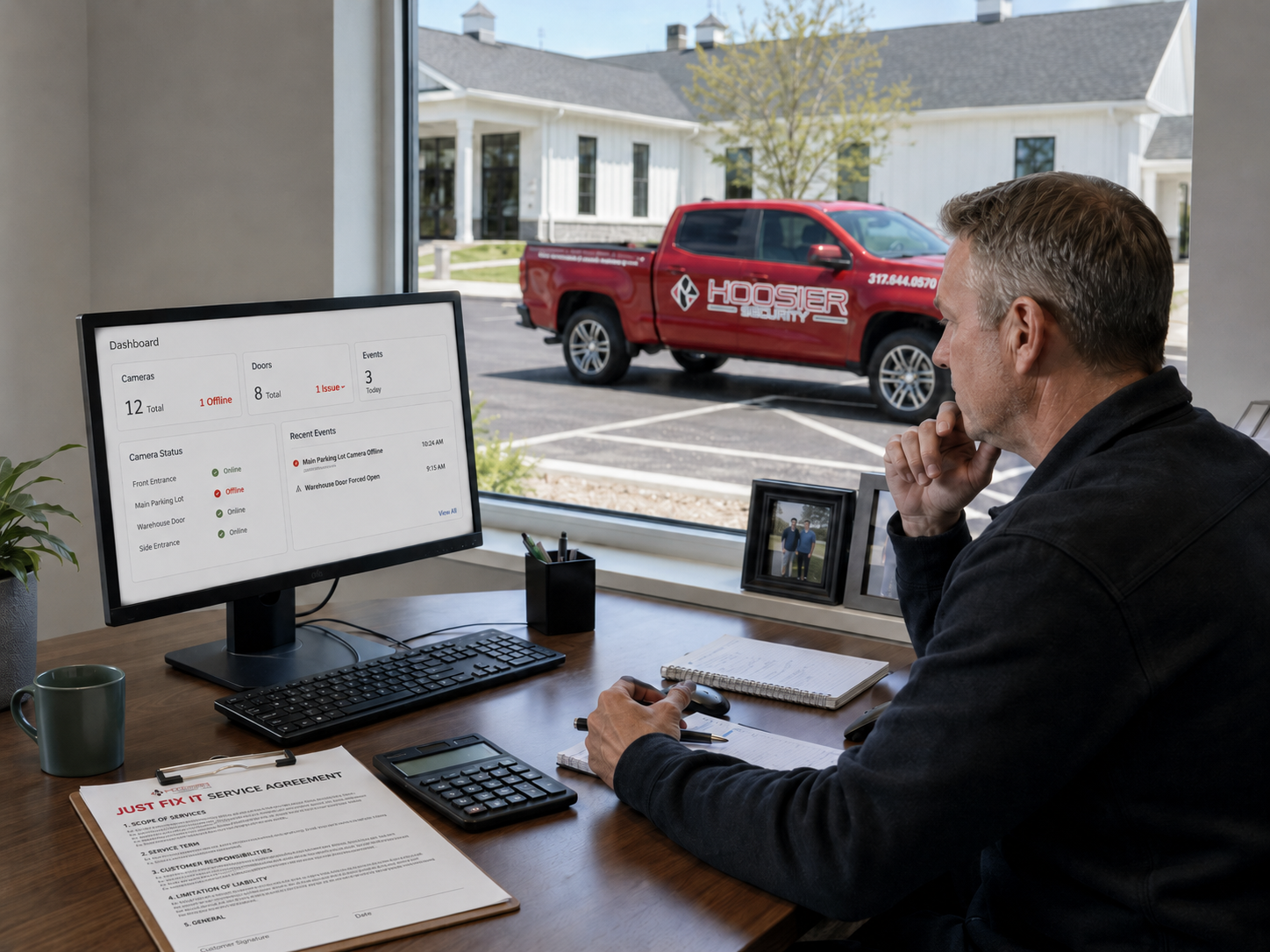
Instead of treating every issue like a separate emergency, JFI gives your team one predictable monthly fee for service support. It includes a 1-business-day fix guarantee, free loaners, free batteries, and no exclusions.
That matters because most service agreements create fine print. JFI is designed to be simple: when something breaks, Hoosier fixes it.
For property managers and facility teams, that means fewer surprise invoices, fewer approval delays, fewer tenant complaints, and less time spent chasing vendors.
What Should a Commercial Security Service Agreement Include?
A commercial security service agreement should make service simpler, faster, and easier to budget. It should not create more confusion.
Look for a service agreement that includes:
- Clear response expectations
- Predictable monthly cost
- Coverage for common repair issues
- Support for cameras, access control, alarms, and related devices
- Loaner equipment when needed
- Battery replacement support
- Minimal exclusions
- A service team that understands your installed systems
- Clear communication from ticket to resolution
The goal is simple. Your system should work when it matters, and your team should not have to manage every repair from scratch.
The $500 Repair That Became a Portfolio Headache
A property manager notices that an exterior camera is offline at one industrial building. At first, it looks like a small repair.
Then the cost starts to grow. A service call is scheduled. The technician diagnoses the issue and finds that a part needs to be replaced. The part is not on the truck, so a return visit is required. In the meantime, a tenant complains because the camera covers a shared loading area. The property manager has to update the tenant, approve the quote, coordinate the return visit, and explain why the system was down.
The repair bill was not the real cost.
The real cost was the downtime, the tenant frustration, the repeat coordination, and the risk of not having footage if something happened during the outage.
That is exactly the kind of headache a predictable security system maintenance contract is meant to prevent.
How Can Property Managers Reduce Vendor Management Headaches?
The easiest way to reduce vendor management headaches is to stop treating every service issue like a new project.
Security repairs should not require a long email chain, multiple approvals, unclear coverage, and surprise invoices every time something breaks. Property managers need a service partner that takes ownership of the problem and fixes it quickly.
Hoosier’s Just Fix It program supports that model. It gives teams a clearer path:
- Report the issue.
- Hoosier diagnoses and fixes the problem.
- Your team gets back to managing the property, not managing the repair.
That is the difference between a vendor and a service partner.
When Should You Consider a Security System Maintenance Contract?
You should consider a security system maintenance contract when repairs are becoming unpredictable, slow, expensive, or difficult to coordinate.
Common signs include:
- You are paying for multiple emergency repairs each year
- Cameras or access control devices go down without warning
- Tenants report issues before your team knows about them
- Repair approvals slow down response time
- You are managing too many vendors across properties
- Your system works most days, but not always when it matters
- You want a predictable monthly service cost instead of surprise invoices
For multi-site teams, this is especially important. A repair process that feels manageable at one building can become a serious operational problem across a full portfolio.
How Does This Connect to Systems That Actually Work?
Security systems should do more than exist on the wall. They need to work consistently.
That is why service belongs in the same conversation as cameras, access control, alarms, and monitoring. A system that is not maintained becomes a liability. A camera that is offline cannot help with an investigation. A failed reader can create access problems. A weak alarm battery can trigger avoidable service issues.
A commercial security service agreement helps protect the investment you already made. It keeps the system functional, reduces downtime, and gives your team a cleaner way to manage repairs.
FAQ
What is a commercial security service agreement?
A commercial security service agreement is a support plan for your security system. It helps cover repair response, maintenance needs, and service coordination for systems like cameras, access control, alarms, and related devices.
The goal is to reduce surprise repair costs and make service more predictable.
How much do commercial security repairs usually cost?
The visible repair may look small, but the total cost can grow quickly. A service call, after-hours premium, truck roll, parts, diagnostic labor, and return visit can turn one issue into a $1,500 to $3,000 incident.
The exact amount depends on the system, timing, parts, and labor required.
What is Just Fix It from Hoosier Security?
Just Fix It is Hoosier Security’s service program that helps customers avoid unpredictable repair headaches. It includes one predictable monthly fee, a 1-business-day fix guarantee, free loaners and batteries, and no exclusions.
It is designed for organizations that want their security systems fixed quickly without fighting through surprise service costs and fine print.
Does a security system maintenance contract cover cameras and access control?
A strong maintenance contract should support the major components of your commercial security system, including cameras, access control, alarms, batteries, and related devices.
Coverage depends on the provider, which is why it is important to ask what is included, what is excluded, and how quickly repairs are handled.
Why is predictable service important for property managers?
Predictable service helps property managers reduce tenant complaints, control repair costs, and avoid unnecessary vendor coordination. It also helps keep cameras, access control, and alarm systems working when incidents happen.
For multi-site property teams, predictable service can make the difference between managing a repair and managing a portfolio-wide headache.
See How Just Fix It Works
Unplanned repairs are not just a maintenance issue. They are a cost, risk, and vendor management problem.
Book a Hoosier Security Experience Center session to see how Just Fix It helps commercial property managers and facility teams keep security systems working with one predictable monthly fee, a 1-business-day fix guarantee, free loaners and batteries, and no exclusions.